


Playing Against a Stacked Deck
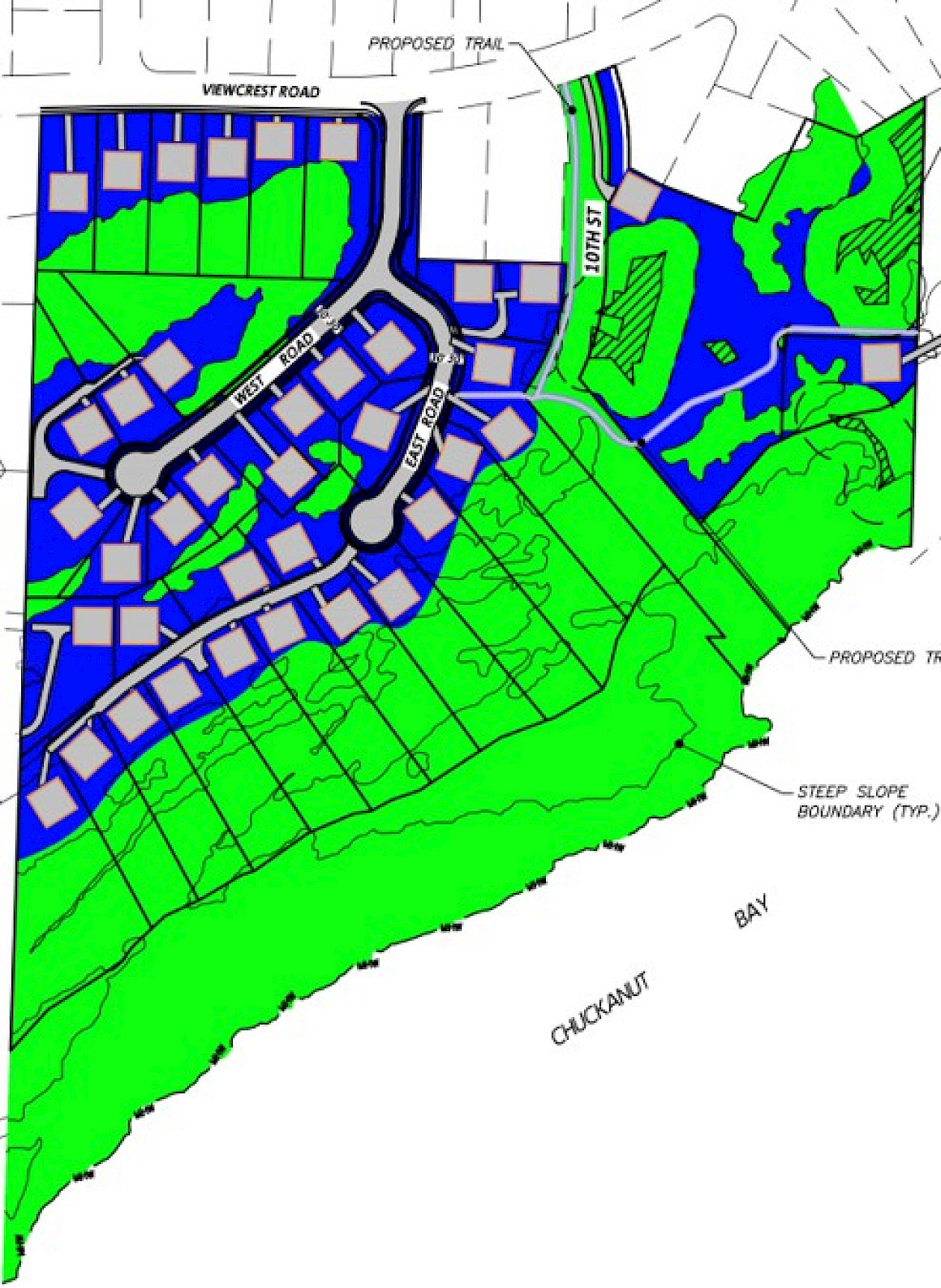
Blue and Gray Areas Intended for Development.
Playing Against a Stacked Deck
Playing Against a Stacked Deck
This fourth article updates the progress of The Woods at Viewcrest, a proposed 38-lot urban subdivision that would replace forested cliffs upslope from North Chuckanut Bay, also known as Mud Bay.
The Woods at Viewcrest has become a flashpoint not only because of what would be built, but because of where it would be built: above fragile coastal bluffs, near protected public-trust marine waters, and within a landscape already constrained by steep slopes, wetlands, erosion hazards, landslide hazards, and fish & wildlife habitat conservation critical areas.
Over the past five years, opposition to this poorly designed project has grown into a broad public opposition, drawing critical comment letters, technical analyses, and sustained responses from:
a) Protect Mud Bay Cliffs (PMBC)- an organization with more than a thousand community members supporting efforts to protect the coastal cliffs, neighboring properties, and public health and safety;
b) Environmental groups- such as the Sierra Club, RE Sources, and the Whatcom County Marine Resources Committee (MRC);
c) An array of professional experts;
d) Neighborhood organizations—such as the Edgemoor Neighborhood Association, the Briza Community Organization, the South Neighborhood Association, and Woodlands HOA;
e) Community members who have submitted a tidal wave of public concerns and comments to city staff;
For years, a united public front has grown larger and broader as residents studied the project record and uncovered a pattern of unresolved risks, softened standards, missing reports, misrepresentations, and unanswered questions.
Concerns grew about stormwater, slope stability, traffic, habitat loss, and the long-term health and safety of the community and North Chuckanut Bay. To many residents, the proposed 38-lot subdivision was never simply a housing project, it was a development proposal that would negatively affect a surrounding community and nearby fragile and protected public trust marine waters. Further, there has been an avalanche of requests for environmental studies and analyses to protect the health and safety of the community.
Concerned citizens challenged the city’s conclusions, arguing that the project’s poorly managed stormwater, reduced buffers, road design, and hazard assessments left too many critical questions unanswered. The public substantiated, and argued:
a) the city’s review repeatedly relied on landowner and applicant statements that were inconsistent, biased, misleading, incomplete, inaccurate, unsupported, or contradicted by the project record itself; and
b) the city’s willingness to approve risky design exceptions reinforced the impression that mandatory health and safety standards were being bent to fit the project, instead of requiring the project to prove that the land, site conditions, and infrastructure could safely support the development.
Failing the Public
On August 21, 2026, the Bellingham City Council denied Protect Mud Bay Cliffs’ appeal to the hearing examiner’s approval of The Woods at Viewcrest Preliminary Plat. Community reaction to the decision was not simply disappointment; it was a deepening loss of trust.
For many residents, the city’s approval of this large, and deeply flawed subdivision confirmed a growing community fear: that Bellingham’s planning process is failing to protect public health, safety, and the environment when doing so would obstruct a preferred development path.
Residents who followed the review saw mandatory analysis left undone, regulatory noncompliance excused, exceptions granted, standards softened, and public evidence marginalized as merely a “different side” instead of treated as substantive evidence of unresolved risk.
The Woods at Viewcrest approval is not just one disputed subdivision decision. It represents a more troubling failure in Bellingham’s planning process—a process that appears to safeguard privately agreed-to development pathways while minimizing, reframing, or dismissing the public’s warnings.
The result is a widening civic wound, with the community watching troubling and incomplete development plans move forward while being told to live with the long-term consequences.
For many community members, the decision on The Woods at Viewcrest confirmed that Bellingham’s planning processes allow public participation in appearance only, but fail to respond meaningfully when that participation exposes serious flaws in a proposed development.
Public participation becomes little more than a grudgingly managed procedural step where residents may speak, submit expert analysis, and document risks, yet time after time, those concerns are minimized or ignored once they threaten the preferred approval path.
Resident anger continues to grow because objections are being treated as ‘the usual’ casual complaints, and evidence is being reframed as merely a “different side” of the issue. City staff presented the development disputes as a set of competing opinions, when clearly, the public had submitted factual, technical, and site-specific evidence about the project’s unresolved risks and harmful impacts.
By approving this development, the Bellingham City Council and the city’s hired hearing examiner, Sharon Rice, reinforced the public’s belief that participation in city governance will be narrowly confined, tightly controlled, and ultimately, easily disregarded when it challenges the preferred approval path.
That loss of trust is not abstract; it is a predictable result of specific choices residents watched the city make throughout the review process.
The city’s planning process failed the public in several specific ways:
1) The strength of the public’s comment letters, expert analyses, and technical evidence was discredited or disregarded as inconsequential in the city’s planning and decision-making.
2) Community members showed up and participated, testified, appealed, wrote to city planners, used expert information to substantiate public concerns, and returned, again and again, to a city planning process that failed to value their participation.
Conflicting with The Preferred Approval Path.
PMBC’s appeal of the city hearing examiner’s Approval Decision identified 24 unresolved questions remaining at the time of preliminary plat approval, along with 22 compliance determinations that were deferred until after approval.
Together, these 46 documented issues go to the heart of the public’s concerns about whether this subdivision can be safely and lawfully developed. Those concerns center on inadequate stormwater management, unresolved slope-stability risks, missing hydrologic and hydraulic modeling, unproven lot feasibility, and the city’s failure to apply a precautionary approach where critical-area science remains incomplete or uncertain. See BMC 16.55.180(D) which states “…the director shall take a ‘precautionary approach,’ that strictly limits development and land use activities until the uncertainty is sufficiently resolved.”
Citizen efforts to protect North Chuckanut Bay, its cliffs, neighboring properties, and public health and safety will continue. State and federal regulatory authorities beyond the city’s insular approval process—including the Washington Department of Ecology, Washington Department of Fish and Wildlife, and the U.S. Army Corps of Engineers—still have jurisdictional reviews actively in process.
The city’s handling of this proposal has already caused serious damage to public trust, regardless of whether the project ultimately moves forward. To residents, the city’s review process made one thing painfully clear, again: No matter how clearly the public speaks, how strong its analysis is, or how truthful and well-documented its warnings are, Bellingham decision-makers will discount that input when it conflicts with the preferred approval path. [See Related File below for additional information.]
WHY?
The city does not have to acknowledge or address what they do not find, and they do not find what they do not look for.


2 Comments, most recent 3 weeks ago